

“We’re building an AI-first platform.”
If I had a dollar for every time I heard that in a pitch deck, I’d have enough to train my own LLM.
Let’s be honest, AI is the buzzword du jour. Founders are rushing to integrate it into everything from note-taking apps to nail salon booking systems. And while investors may nod at the term "AI-first," most products labeled that way are… well, not really.
Here’s a quick test:
Are you solving a user problem?
Or are you solving for “How do I use GPT somewhere in this UI?”
If it’s the second one, you might be building a tech demo, not a product.
In this blog, we’ll break down the common missteps founders make when chasing the “AI-first” dream and what it takes to build a product where AI isn’t just a feature, but the foundation.
The Myth of the ‘AI-First’ Label
“AI-first” sounds impressive on a pitch deck. It signals innovation, scale, and investor appeal. But in practice, it often turns out to be just that, a label.
Too many founders confuse using AI with being AI-first. Adding GPT to your product doesn’t make it intelligent; it makes it trendy. True AI-first products are designed around AI capabilities, not with AI added as an afterthought.
The difference?
A real AI-first product reimagines workflows, decisions, and user outcomes with AI at the core.
A vanity AI product… just auto-completes your sentences.
The takeaway: Slapping a model on top of an app doesn’t create value. Solving real problems with AI at the foundation does.
Common Mistakes Founders Make
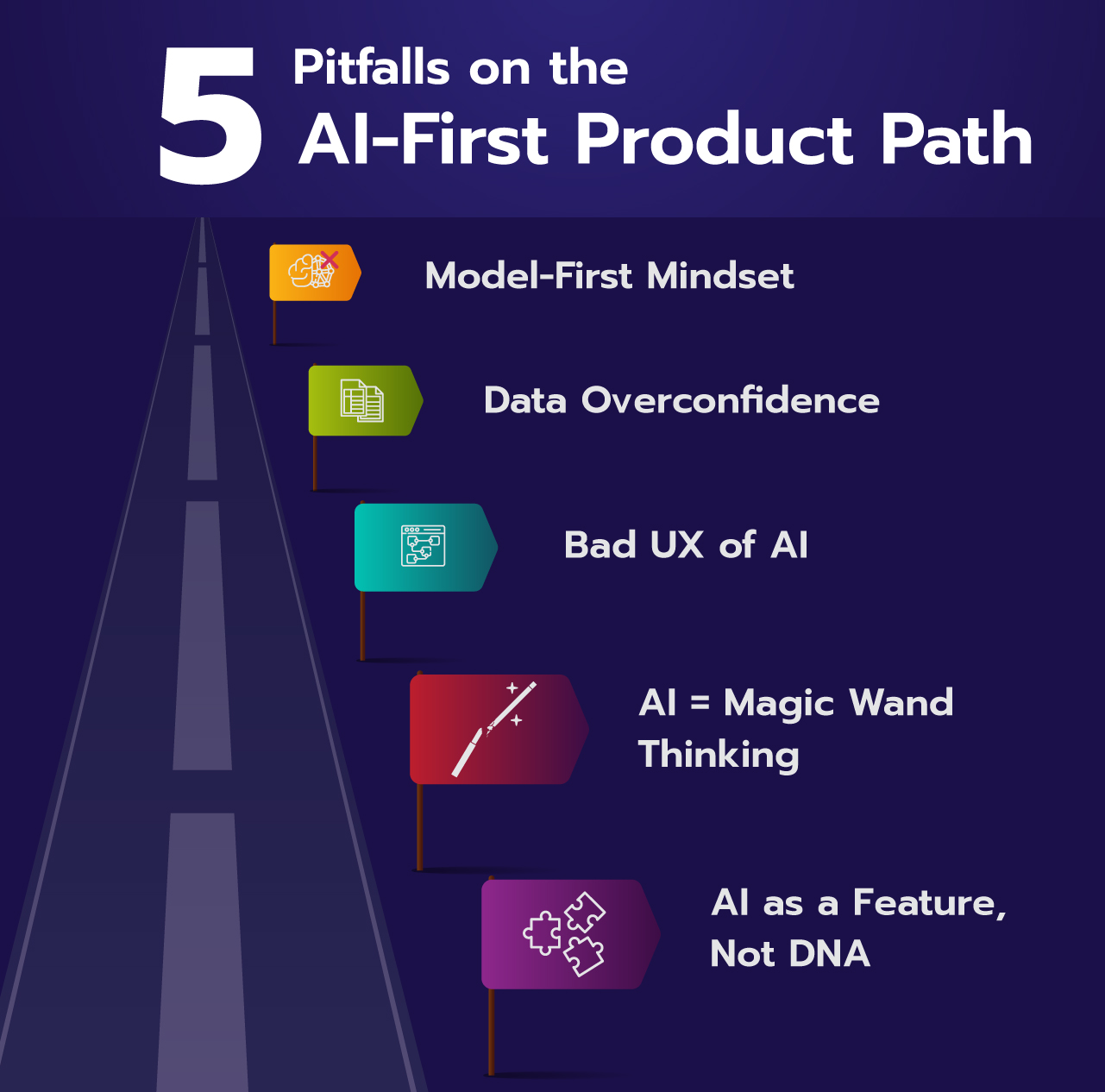
For many founders, building an “AI-first” product sounds like a bold move. But without the right foundation, bold quickly turns into broken. Here are the 5 most common missteps we see:
1. Starting with the Model, Not the Problem: It’s tempting to dive headfirst into the latest LLM or fine-tuning trick. But great products don’t start with a model; they start with a real user pain point.
Example: You build a chatbot… before knowing what users need help with. The result? A fancy interface that answers all the wrong questions.
2. Overestimating Data Readiness: Founders often assume, “We have tons of data, training a model should be easy.” But quantity ≠ quality.
What you usually find is messy, biased, or sparsely labeled data that’s nowhere near model-ready. Without proper curation, even the best algorithm can’t save you.
3. Ignoring the UX of AI: AI doesn’t just need to work; it needs to feel trustworthy. That means clear explanations, user control, and feedback loops.
A sleek model spitting out answers with no context or transparency might impress on paper, but it frustrates real users.
4. Thinking AI Will Magically “10x” the Product: AI isn’t a silver bullet. It won’t suddenly make your product 10x better unless the core product already delivers value.
Yes, AI can boost productivity, but productivity doesn’t guarantee product-market fit. You still need to solve a real, painful problem.
5. Building AI as a Feature, Not a Core Differentiator: Tacking on AI as a feature makes your product easy to replicate. If your entire AI “strategy” is wrapping GPT in a UI, you’re already behind.
Real defensibility comes from embedding AI into your product’s deep integrations, proprietary data, and workflows that AI truly enhances.
What “AI-First” Should Actually Mean?
If you're leading with the model, you're already out of order. Being AI-first isn’t about showing off the smartest algorithm; it’s about solving the right problem, with the right data, using AI as the accelerator. In the real world, the sequence should look like this:
-
Problem-first: What’s the human pain point you’re solving?
-
Data-second: Do you have the raw material (quality data) to solve it well?
-
AI-third: Can AI meaningfully amplify the solution in a way that users care about?
The best AI-first products don’t shout “Look, AI!” They whisper, “Wow, this just works.”
Here’s what it actually looks like in action:
-
Notion AI: Not just a writing assistant bolted onto notes; it’s integrated into the thinking process itself: summarizing, generating, translating, right where you’re working.
-
GitHub Copilot: It doesn’t sit on the sidelines. It types with you, adapts to your patterns, and saves you keystrokes without disrupting your flow.
-
Descript: Editing video by editing text? That’s a product reimagined from the ground up with AI at the center, not as an add-on.
AI-first isn’t a tech stack decision. It’s a product philosophy.
Let AI live where the user already works. Let it disappear into the workflow. That’s what makes it feel like magic.
How to Do It Right: A Framework for Founders?
Building a truly AI-first product isn’t about picking the right model; it’s about making a thousand right decisions in the right order. Here’s a proven framework founders can use to go from AI hype to real-world value:
1. Start with User Pain: Before anything else, zoom in on friction. Where are users currently frustrated, wasting time, or stuck doing repetitive, manual tasks? That’s where AI can shine, not by being “smart,” but by being useful.
For example, instead of thinking, “Let’s build an AI for customer service,” ask:
“Where do agents spend the most time unnecessarily?”
Maybe it's summarizing call transcripts or categorizing tickets. That’s your entry point.
Why it matters: If there’s no clear user pain, no one will care how impressive your AI is. AI is not a value prop on its own; the outcome is.
2. Map the Data You Actually Have: AI is only as good as the data it learns from, and most startups discover too late that their data isn’t usable. You need to:
-
Inventory: What data is available (user logs, feedback, content, events)?
-
Audit: Is it structured, labeled, and anonymized? Or messy and fragmented?
-
Identify gaps: What do you wish you had to train smarter models?
If your product relies on AI to make decisions, but 80% of your key events are untracked, you’re not ready to go AI-first; you’re data-last.
Pro tip: Start capturing the right data now, even if you’re not ready to train models yet. Clean, consistent data is your future moat.
3. Prototype AI as a Co-Pilot, Not a Black Box: Users don’t want an all-knowing robot—they want a helpful, predictable assistant. Design your AI to augment, not automate, the user’s journey. That means:
-
Letting users understand why the AI made a decision
-
Giving them the ability to undo or adjust outcomes
-
Designing the interface to reflect uncertainty (e.g., “Not sure? Here are 3 options.”)
Example: Think of GitHub Copilot; it suggests code, but you’re still driving. It helps, but it doesn’t take over.
4. Validate Early and Often: Don’t wait until your model hits 95% accuracy to launch a beta. Real-world feedback is often more valuable than fine-tuning.
-
Build a scrappy version with mock AI or partial automation.
-
Get it in front of users. Observe where they hesitate, where they smile, and where they ignore the feature.
-
Iterate fast based on behavior, not just feedback.
Founders often hide behind the model, obsessing over precision while the user doesn’t even care. Sometimes 70% right with great UX beats 98% right with clunky delivery.
5. Align Your AI Ambition with Your Go-To-Market Strategy: Here’s a hard truth: your customer may not care that your product is AI-powered. They care if it saves time, cuts costs, or gets better results. So ask yourself:
-
Are we selling AI, or are we selling outcomes?
-
Does the AI unlock something users couldn’t do before?
-
Will this feature support a pricing premium, a faster onboarding, or a stronger retention loop?
For example: Descript doesn’t market itself as “AI-powered.” It sells the promise of “edit videos like a doc.” The AI is what makes that possible, but the value is the workflow transformation.
The Bottom Line: AI isn’t the starting point; it’s the multiplier. Start with real-world friction, build with data discipline, design for trust, and deliver clear outcomes. That’s how you go from "AI-first" as a label…to "AI-first" as a product advantage. The real value of AI doesn’t come from being early adopters of the latest model; it comes from being relentlessly focused on solving problems better, faster, and smarter.
Founders who succeed with AI-first products understand this: AI is not the product. The experience it enables is. So before chasing benchmarks or model sizes, ask:
-
Are we solving a real user pain?
-
Do we have the data to back it?
-
Are we building trust, not just automation?
The path to true AI-first success is rooted in clarity, discipline, and iteration, not just hype.
How AtliQ Can Help?
At AtliQ Technologies, we don’t just build AI, we help you build the right kind of AI. Whether you’re an early-stage founder looking for clarity or a scaling startup needing custom AI solutions, our consulting-first approach helps you:
-
Identify high-impact AI opportunities in your product.
-
Audit your data readiness and design scalable AI pipelines.
-
Prototype with purpose. Turning concepts into real, testable workflows.
-
Embed AI into your product DNA, not just as a feature but as a differentiator.
We’ve helped 73+ clients across industries unlock the real power of AI; no buzzwords, just results.
Let’s help you build the product your users didn’t even know was possible.