

It’s 2 AM.
Your mind won’t stop racing.
You don’t want to bother anyone.
Booking a therapy session feels like “something for later.”
So you open an AI chat instead.
You’re not alone.
More than 1 billion people globally are living with mental health conditions, yet access to professional support is still limited and uneven.
In fact, two-thirds of people with mental health issues don’t receive the care they need.
And that gap is exactly where AI has stepped in.
From late-night conversations to daily emotional check-ins, AI tools are quietly becoming the first place people turn to when they need someone or something to listen.
Which brings us to the big question: Can AI actually replace therapists… or is it just filling a space we’ve left empty?
What AI Can Actually Do Well in Mental Health?
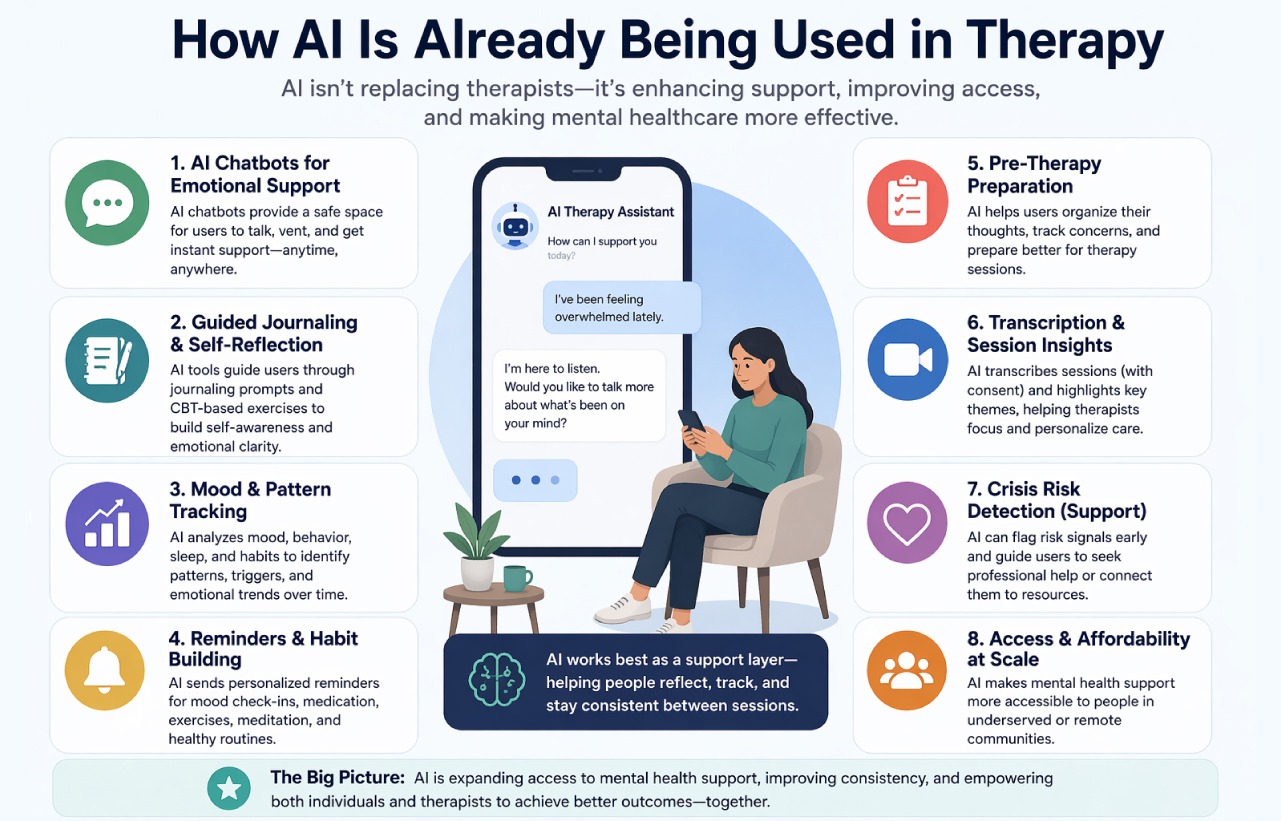
AI is not a therapist, but it is proving to be a powerful support system in specific, well-defined ways. When used correctly, it can fill critical gaps in accessibility, consistency, and everyday emotional support.
24/7 Emotional Support: One of AI’s biggest advantages is availability. Mental health struggles don’t follow schedules. Anxiety can hit at midnight. Overthinking can spiral at 3 AM. And in those moments, waiting days for an appointment isn’t practical. AI offers:
- Immediate responses during moments of stress or anxiety
- A space to express thoughts without delay
- Consistent availability, regardless of time or location
While it doesn’t replace human comfort, it ensures that no moment of distress goes completely unsupported.
Guided Conversations & Journaling: AI excels at structure. Many mental health improvements come from consistent reflection, but most people don’t know how to process their thoughts. This is where AI becomes useful. It can:
- Guide users through structured prompts
- Encourage reflection through step-by-step conversations
- Introduce CBT-based techniques like reframing negative thoughts
Instead of vague journaling, users get direction, clarity, and continuity in their self-reflection.
Pattern Recognition: Over time, AI can identify patterns that are hard for individuals to notice on their own. By analyzing repeated inputs, it can:
- Track mood fluctuations
- Identify recurring triggers or stressors
- Highlight behavioral or emotional trends
This shifts mental health from reactive to slightly more proactive, helping users understand not just what they feel, but why they feel it.
Reducing Stigma: For many people, opening up is the hardest step. AI removes the fear of judgment. There’s:
- No social pressure
- No fear of being misunderstood
- No hesitation in sharing “embarrassing” thoughts
This often leads to more honest and uninhibited expression, especially for those who are not yet comfortable seeking professional help.
Insight: AI works best as a support layer helping people express, reflect, and cope in the moment. But support is not the same as healing.
Where AI Falls Short (The Human Gap)?
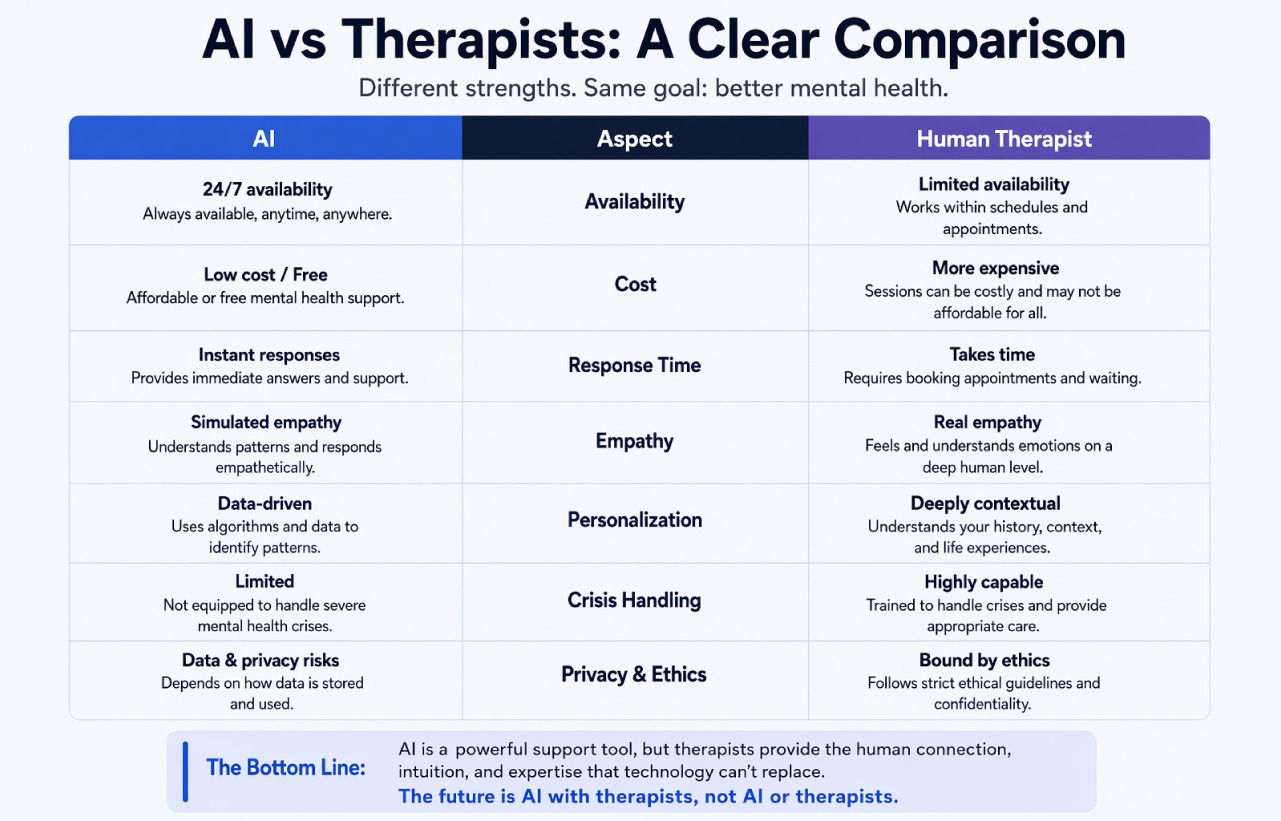
For all its strengths, AI has clear and critical limitations, especially when it comes to the depth and complexity of human emotions. This is where the difference between assistance and therapy becomes undeniable.
Lack of True Empathy
AI can generate empathetic responses. But it does not feel empathy. There’s a fundamental difference between:
- Recognizing emotional cues
- And genuinely understanding emotional pain
Human therapists bring lived experience, emotional intelligence, and presence that AI cannot replicate.
No Deep Contextual Understanding: Mental health is deeply personal and contextual. It’s shaped by:
- Past experiences
- Cultural background
- Relationships and environment
AI operates on patterns and probabilities. It often misses nuance, long-term context, and the unspoken layers behind emotions.
Crisis Handling Limitations: This is one of the most critical gaps. AI is not equipped to safely handle:
- Severe depression
- Trauma
- Suicidal thoughts or crises
In high-risk scenarios, delayed or incorrect responses can be dangerous. Human therapists are trained to assess risk, intervene, and provide appropriate care. AI is not.
Ethical & Privacy Concerns: Mental health data is deeply sensitive. Using AI raises important questions:
- Where is this data stored?
- How is it used?
- Who has access to it?
Additionally, there’s a growing risk of emotional over-reliance on AI, where users substitute real help with continuous AI interaction.
Insight: Therapy is not just conversation; it’s connection, trust, and human intuition.
The Real Role of AI in Mental Health (The Hybrid Model)
The debate isn’t AI vs therapists.
It’s about how both work together.
AI as the First Layer of Support: AI fits into everyday mental health, not deep therapy, but daily support. It helps with:
- Daily check-ins to build awareness
- Habit tracking (mood, sleep, routines)
- Pre-therapy preparation by organizing thoughts
This shifts mental health from: Occasional sessions → to → continuous support
Where Therapists Remain Essential: Therapists step in where AI cannot:
- Trauma and deep emotional work
- Complex processing rooted in personal history
- Behavioral change that needs trust and accountability
These require human intuition, empathy, and lived understanding.
The Shift: From Sessions to Systems
AI adds a continuous layer of insight. Therapists bring depth and direction. Together, this leads to:
- More informed sessions
- Better pattern recognition
- More personalized care
Insight: The future is not AI or therapists, it’s AI with therapists.
What does this mean for the Future?
AI is not replacing therapists, but it is reshaping how mental health support is accessed, delivered, and experienced. We’re moving toward a model where support is:
- More accessible- available anytime, not just during scheduled sessions
- More continuous- built into daily life, not limited to occasional conversations
- More proactive- identifying patterns early instead of reacting late
At the same time, the role of therapists will evolve, not diminish. They will:
- Focus more on deep, high-impact interventions
- Use AI-driven insights to better understand patients
- Deliver more personalized and effective care
The biggest shift is this: Mental health support will no longer be session-based.
It will become a system where AI handles consistency and scale, and humans deliver depth and transformation. The future of mental health isn’t about choosing between technology and humans; it’s about designing systems where both work together to make care more effective, accessible, and human at its core.
AI is changing how we approach mental health, but not in the way many assume.
It’s not here to replace therapists.
It’s here to fill the gaps that traditional systems couldn’t access: consistency and immediacy.
But mental health is not just about being heard. It’s about being understood.
And that requires something AI cannot replicate: human connection, intuition, and trust.
The real opportunity lies in combining both.
Using AI to support the everyday moments.
And relying on human therapists for the work that truly transforms lives.
The question isn’t “Can AI replace therapists?” It’s “How can we use AI to make mental health support better for everyone?”
Looking to build responsible AI solutions in healthcare? Let’s explore how to create systems that are intelligent, ethical, and human-first.