

If you are running an IT services company right now, you already know what the treadmill feels like.
Every month starts from zero. You chase new projects, pitch new clients, write new proposals. You deliver great work, the project ends, and the cycle starts again. Revenue is unpredictable. Growth is slow. And you are always one lost client away from a rough quarter.
There is a better path. And it does not require raising millions or building the next big SaaS platform.
It starts with something small. Really small. A micro product.
What is a micro product?
A micro product is a focused, simple tool that solves one specific business problem. It is not a full-blown enterprise software suite. It is not an app with fifty features. It is one thing, done well, that people are willing to pay for.
Think of it as packaging your expertise into a product instead of selling it as a service.
If your team has been building custom CRM integrations for clients, maybe there is a common pattern you keep repeating. That pattern could be a micro product. If you keep solving the same invoicing issue for different small businesses, that solution could be a micro product.
The key is that it already exists in your experience. You just have not packaged it yet.
But here is the part most people skip
Everyone gets excited about building. That is the fun part. You sketch out features, design screens, write code, and push something live. But the product is not the hard part anymore — especially with the way AI-assisted coding is moving.
The hard part is making sure you are solving a real problem.
Before you write a single line of code, before you even open your laptop, sit down and think about three things.
First - what is the real-world business use case? Not a hypothetical one. Not something you think might be useful. A problem you have personally seen businesses struggle with. Something you have watched people waste time on, lose money on, or get frustrated by.
Second - what is the actual business problem behind it? Go deeper than the surface. If a client says "we need better reporting," the real problem might be that they are making decisions on outdated data, or that their team spends four hours every Monday compiling numbers manually. Understand the pain, not just the symptom.
Third - what is the simplest solution that solves this? Not the most impressive solution. Not the most feature-rich. The simplest one that a user would pay for because it removes their pain.
Only after you have answered all three should you start building.
Why vibe coding changes the math
Here is where it gets interesting for IT companies specifically.
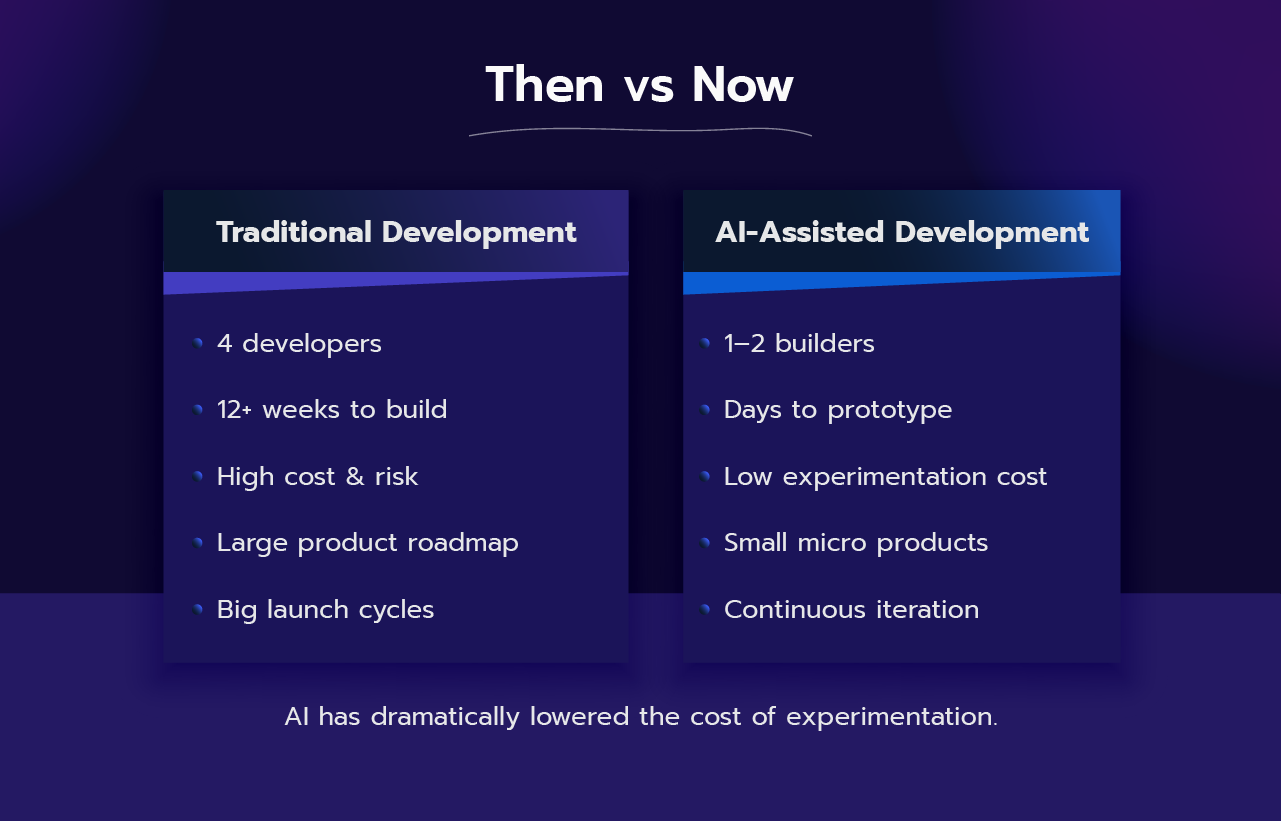
The cost and time to build a micro product has dropped dramatically. With AI-assisted coding - what people are now calling vibe coding - you can go from idea to working prototype in days, not months.
A team that used to need four developers and twelve weeks to build a basic tool can now get a working version out with one or two people in a fraction of that time. The execution cost has fallen through the floor.
This means the risk of building a micro product is lower than it has ever been. You are not betting six months of payroll on an idea. You are betting a few weeks. And if the idea does not work out, you move on to the next one without burning through your runway.
For IT companies, this is a massive opportunity. You already have the technical skills. You already understand business problems because you have been solving them as services. Now you can package those solutions at a fraction of the cost you would have spent even two years ago.
The shift from selling time to selling value
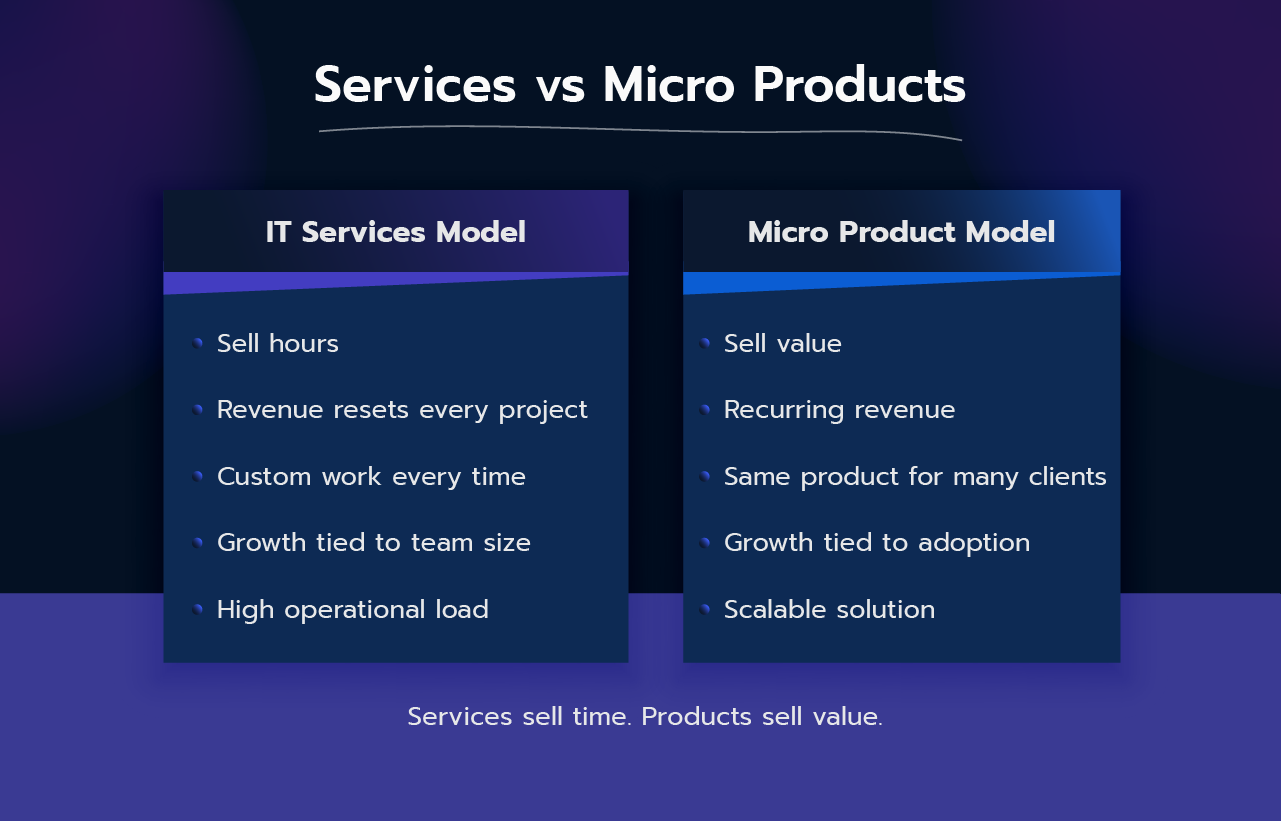
This is the real transformation. When you sell services, you are selling time. When you sell a product, you are selling value.
A client pays you for thirty hours of development work, and that is the end of it. But if you build a micro product that saves a business ten hours a week, you can charge for it every single month. That is recurring revenue. That is compounding.
And here is the best part - the same product that took you two weeks to build can serve a hundred customers. Then a thousand. Your effort stays the same, but the return keeps growing.
IT companies already have the hardest ingredient to get - deep understanding of business problems and the ability to build solutions. The missing piece was always the cost and risk of product development. Vibe coding removes that barrier.
Start small, learn fast
You do not need to go all in. Keep running your services business. But take a small team - even just two people - and dedicate a few weeks to building one micro product based on the most common problem you keep solving for clients.
Get it into the hands of real users. See if they will pay for it. Listen to their feedback. Improve it.
If it works, you have just planted the seed of a product business that will grow alongside your services. If it does not work, you have learned something valuable at a very low cost.
Either way, you win.
The IT services treadmill is exhausting. Micro products are the way off it. And there has never been a cheaper, faster time to start building them.
The question is not whether you can afford to try. It is whether you can afford not to.