

Building an AI product is exciting, but rushing into development without proper preparation can lead to wasted time, resources, and even failure. Imagine investing months into creating an AI model only to realize it doesn’t have enough quality data to function effectively. Or worse, launching a product that faces ethical backlash due to bias.
Before you dive into coding and model training, there are five crucial things you need to take. Think of them as your AI survival kit—without them, your journey might be rough. Let’s explore what they are and why they matter.
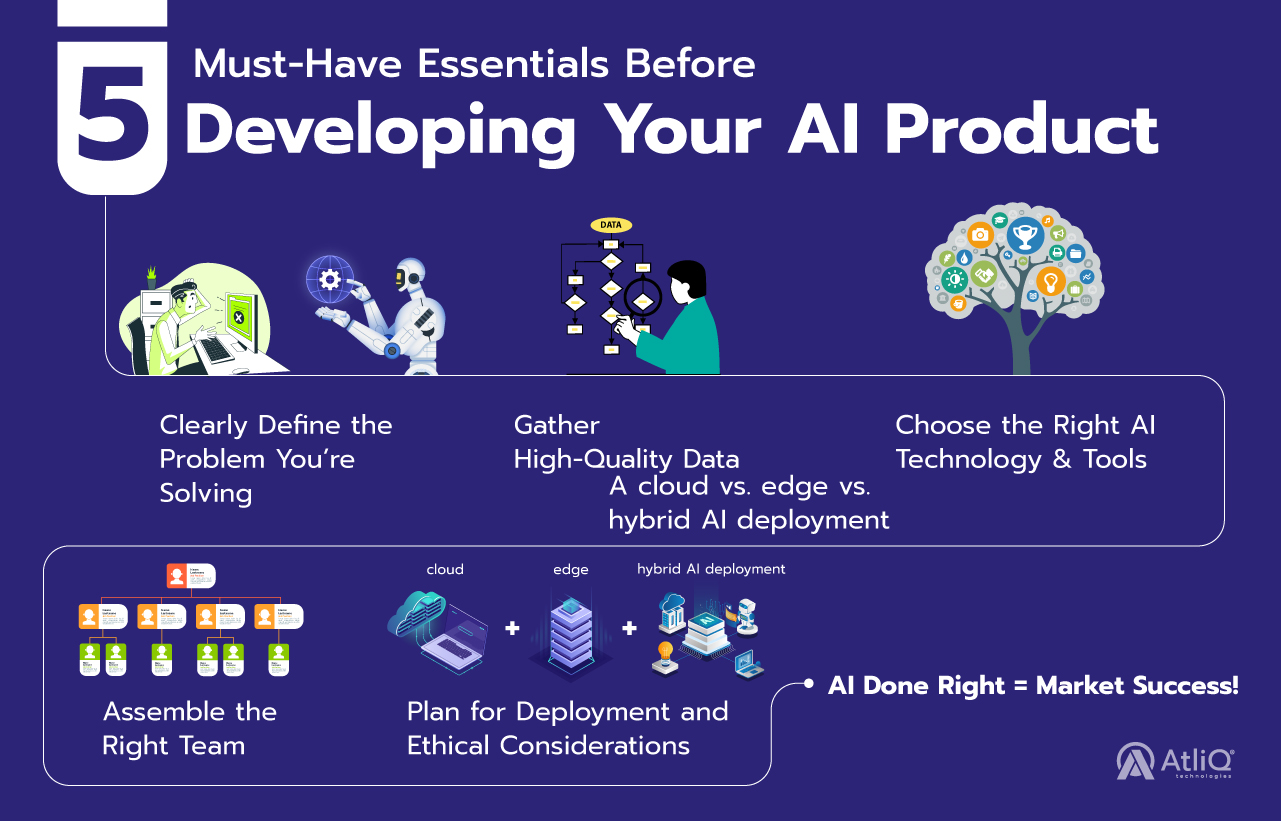
Clearly Define the Problem You’re Solving
Before developing an AI product, the first step is to identify the core problem it aims to solve. AI should be a solution, not just a buzzword. Ask yourself: What inefficiency, challenge, or gap does this product address? A common mistake many businesses make is developing AI for innovation rather than necessity. Without a clear problem statement, even the most advanced AI models can become useless.
How to Ensure a Real Market Need?
-
Conduct thorough market research to validate demand.
-
Gather feedback from potential users to understand pain points.
-
Study competitors to identify gaps in existing solutions.
For instance, AI-powered chatbots have revolutionized customer service by reducing wait times and providing 24/7 support. Businesses struggling with high customer service costs and long response times found real value in integrating AI chatbots.
By defining a strong problem statement early on, you lay the foundation for an AI product that delivers real impact—not just hype.
Gather High-Quality Data
AI is only as good as the data it learns from. Without high-quality data, even the most advanced algorithms will produce inaccurate, biased, or unreliable results. Before you start developing your AI product, you need to define the type of data required, its sources, and how it will be processed.
Identify the Right Data Sources
-
Structured Data: Databases, CRM systems, financial records.
-
Unstructured Data: Images, videos, social media posts, customer reviews.
-
Real-Time Data: IoT devices, sensors, live transactions.
Once you have a clear understanding of your data needs, ensure it meets these key standards:
Data Quality Essentials
-
Clean & Accurate: Remove duplicates, missing values, and inconsistencies.
-
Diverse & Unbiased: Avoid skewed datasets that could lead to discriminatory AI decisions.
-
Up-to-date: AI models should be trained on the latest, relevant data.
Legal & Compliance Considerations
Handling data comes with responsibility. Make sure you comply with privacy regulations like:
-
GDPR (General Data Protection Regulation) – Ensures data protection and user consent in the EU.
-
CCPA (California Consumer Privacy Act) – Gives consumers control over their personal information.
-
Industry-Specific Regulations – HIPAA for healthcare, PCI DSS for financial transactions, etc.
Neglecting data quality and compliance can lead to poor AI performance and legal issues. Investing in the right data strategy upfront ensures your AI product is effective and ethically responsible.
Choose the Right AI Technology & Tools
Not all AI is built the same. Choosing the right technology stack ensures your AI product is efficient, scalable, and aligned with business needs. The key is to determine which AI approach—machine learning, deep learning, or rule-based AI—best fits your use case.
Which AI Approach is Right for You?
-
Rule-Based AI: Uses predefined rules for decision-making. Best for simple, predictable tasks (e.g., chatbots with scripted responses).
-
Machine Learning (ML): Learns from data patterns to make predictions. Ideal for recommendation engines, fraud detection, and automation.
-
Deep Learning: A subset of ML that uses neural networks for complex tasks like image recognition, speech processing, and autonomous systems.
AI Frameworks & Tools to Consider
Once you’ve chosen your approach, the next step is selecting the right frameworks and platforms:
-
TensorFlow: Google’s open-source framework for building ML and deep learning models.
-
PyTorch: A flexible and developer-friendly deep learning framework, widely used in research and production.
-
OpenAI API: Provides access to powerful AI models like GPT for natural language processing tasks.
-
Scikit-Learn: Great for traditional ML tasks like classification and regression.
Scalability & Integration Considerations
Beyond choosing the right tools, think long-term:
-
Scalability: Can your AI model handle increasing data and user demand?
-
Integration: Will it seamlessly work with your existing tech stack (e.g., cloud platforms, databases, APIs)?
-
Deployment: Cloud-based (AWS, Azure) vs. on-premises—choose based on security and performance needs.
Selecting the right AI technology early on ensures your product is built for efficiency, adaptability, and future growth.
Assemble the Right Team
AI development isn’t a one-person job—it requires a diverse team of experts to bring the product from concept to reality. A well-rounded team ensures that your AI solution is not only technically sound but also practical, scalable, and aligned with business goals.
Key Roles in an AI Development Team
-
Data Scientists: Handle data collection, cleaning, and model training.
-
Machine Learning Engineers: Build, test, and optimize AI models.
-
Software Developers: Ensure seamless integration of AI into applications.
-
Domain Experts: Provide industry-specific insights to refine the AI’s accuracy.
-
Project Managers: Oversee development timelines, budgets, and team collaboration.
Define Roles & Responsibilities Early
Assigning responsibilities helps prevent confusion, misalignment, and wasted resources. Whether you’re working with an in-house team or outsourcing, defining each role ensures smooth execution.
Outsourcing vs. In-House Development
In-House Team:
-
Offers full control over development and intellectual property.
-
Best for long-term AI projects requiring ongoing optimization.
-
Hiring skilled professionals can be time-consuming and costly.
Outsourcing AI Development:
-
Provides access to specialized talent without long-term commitments.
-
Faster development with experts who have experience in multiple AI projects.
-
Potential risks: Less control over the process and possible data security concerns.
Choosing the right team structure is just as important as choosing the right AI technology. Whether you build in-house or outsource, ensuring the right mix of skills will set your AI product up for success.
Plan for Deployment and Ethical Considerations
Building an AI product is just the beginning—how you deploy and manage it determines long-term success. A well-thought-out deployment strategy ensures smooth operation, while ethical considerations help maintain trust and compliance.
Choosing the Right Deployment Model
AI deployment depends on factors like speed, scalability, and security. Consider these options:
-
Cloud AI: Hosted on platforms like AWS, Azure, or Google Cloud for scalability and flexibility.
-
Edge AI: Runs directly on devices (IoT, smartphones) for real-time decision-making with lower latency.
-
Hybrid AI: Combines cloud and edge computing for a balance of speed and scalability.
Selecting the right deployment approach ensures your AI solution meets performance and cost-efficiency goals.
Addressing Ethical Concerns
AI must be transparent, fair, and accountable to gain user trust. Key ethical considerations include:
-
Bias Mitigation: Ensure diverse training data to prevent discriminatory AI decisions.
-
Transparency: Clearly explain how AI makes decisions, especially in sensitive applications.
-
User Privacy: Comply with data protection laws (GDPR, CCPA) and secure user data.
Continuous Monitoring & Improvement
AI models aren’t “set and forget” systems—they require ongoing refinement to remain effective. Best practices include:
-
Real-time monitoring to detect errors and biases.
-
User feedback loops to enhance AI performance.
-
Regular model retraining with updated data.
A solid deployment and ethical framework not only enhances AI performance but also builds credibility and trust in the market.
Developing an AI product is more than just coding an algorithm—it’s about solving real problems, leveraging high-quality data, choosing the right technology, assembling a strong team, and ensuring responsible deployment. Rushing into AI development without these foundational steps can lead to inefficiencies, ethical pitfalls, and even product failure.
By taking these five key steps, you set your AI product up for success, scalability, and sustainability in the long run. Whether you're a startup or an enterprise, careful planning is what separates groundbreaking AI solutions from forgettable ones.
Ready to turn your AI vision into reality?
Let’s build something impactful—get in touch today!