

I’ve seen AI projects with world-class models die silently after launch.
Not because the technology failed, but because no one could prove what changed once it went live.
The dashboard showed predictions. The accuracy numbers looked strong. But when leadership asked, “What’s the business impact?” The room went quiet.
That silence usually points to one thing: an AI initiative built on belief instead of proof.
And belief is a risky foundation for AI.
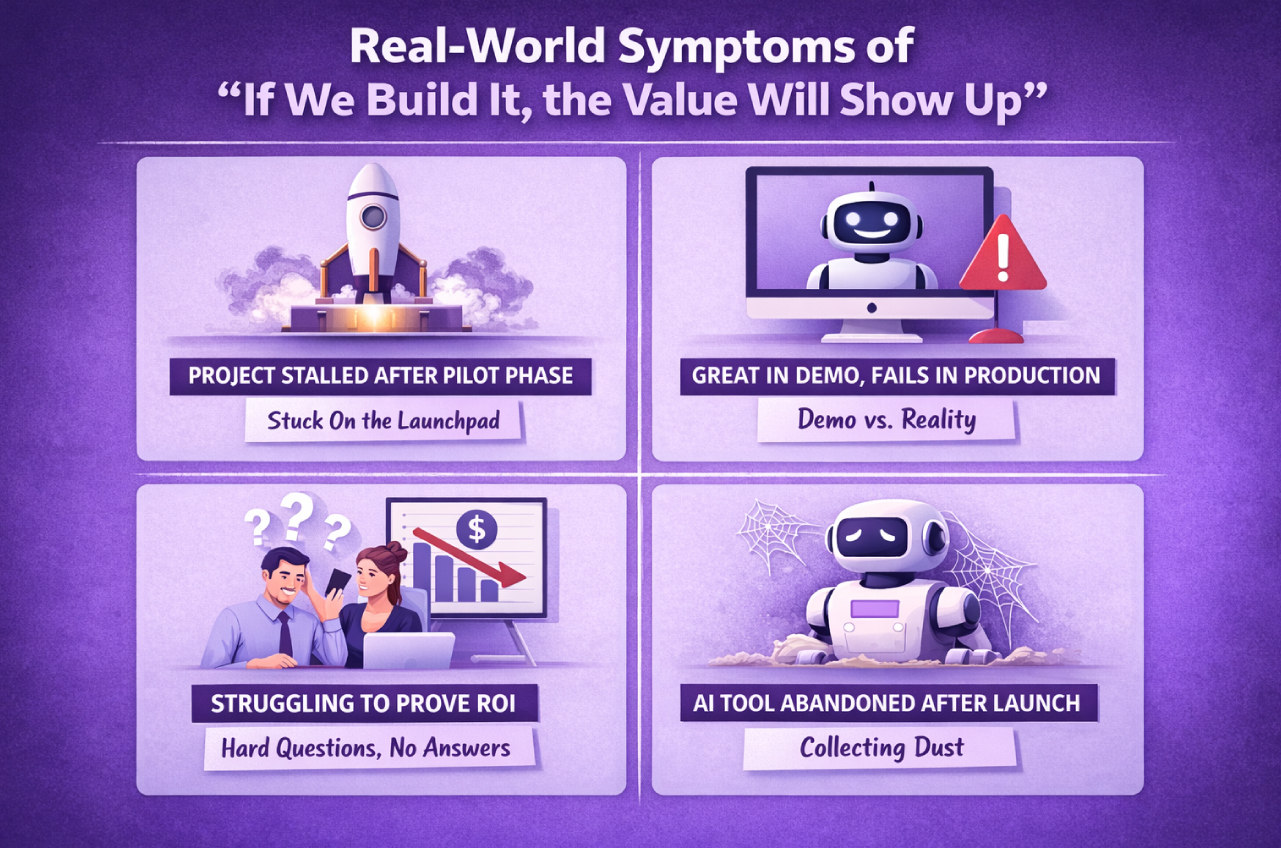
“If we build it, the value will show up.”
Why Is AI Especially Vulnerable to Assumption-Driven Thinking?
AI has a unique way of looking successful, even when it isn’t delivering real value.
Its outputs often sound confident, well-structured, and intelligent. That presentation alone can mask errors, edge cases, or weak reasoning. When AI is wrong, it’s rarely obvious at first glance, which makes teams assume it’s “good enough” long before it’s actually reliable in real-world conditions.
Early prototypes make this even riskier. A limited demo or pilot often works on clean data, narrow scenarios, and controlled inputs. The results look impressive, creating false confidence that the hardest problems are solved. In reality, production environments introduce messy data, exceptions, and human behavior, where most AI systems struggle.
AI’s black-box nature adds another layer of risk. When teams can’t easily explain why a model made a decision, subtle failures go unnoticed. Issues surface only after trust erodes, adoption drops, or results start to conflict with human judgment.
Finally, stakeholders often confuse accuracy with impact. A model can be 90% accurate and still fail to change decisions, reduce workload, or improve outcomes. AI succeeds in business not when it predicts well, but when it moves the needle. Without measuring that difference, assumptions quietly replace evidence.
The Shift: From Assumption to Proof-Based AI Development
At some point, every serious AI initiative needs to make a shift, from believing it will create value to proving that it does.
In AI, proof does not mean higher model accuracy or better benchmarks. Those metrics only show that the system works in isolation. They don’t show whether it works in the real business context where decisions, constraints, and human behavior exist.
Proof in AI is about business outcomes, not technical capability.
It answers questions like:
-
Did this reduce the time spent on a task?
-
Did it lower operational costs or error rates?
-
Did it reduce risk or prevent bad decisions?
-
Did it unlock revenue or improve conversion?
An AI system can be technically impressive yet remain commercially irrelevant. Proof-based development forces teams to tie every AI decision to a measurable outcome; something leadership can see, track, and trust. Without that link, AI remains an experiment, not an investment.
Replacing Assumptions with the Right Questions
The fastest way to eliminate weak assumptions is to ask better questions, early.
Instead of asking “Can we build this?”, proof-driven teams ask:
-
What manual decision or process are we replacing?
If nothing concrete is being replaced or improved, value will remain abstract. -
Who trusts this output and who doesn’t?
Adoption depends on human confidence, not model confidence. -
What happens if the AI is wrong?
Understanding failure impact helps define guardrails, escalation paths, and acceptable risk. -
What measurable behavior should change if this works?
Faster decisions, fewer overrides, reduced effort, improved outcomes; proof must show up somewhere observable.
These questions shift AI conversations from possibility to accountability. They turn vague optimism into clear expectations, and that’s where real AI value starts to emerge.
The Proof-First AI Framework
A proof-first approach treats AI like a business system, not an experiment. Instead of scaling optimism, it scales evidence. This framework helps teams validate value before committing time, budget, and trust.
Phase 1: Assumption Mapping
Every AI project starts with assumptions; most just aren’t written down. At this stage, the goal is to surface every belief about:
-
Where does value come from?
-
Who will use or trust the AI?
-
How accurate does the system need to be to be useful?
By explicitly listing these assumptions, teams can separate facts from hope and identify what actually needs validation. If an assumption can’t be tested, it’s a risk, not a strategy.
Phase 2: Small-Scale Validation
Before scaling, AI must prove itself in a controlled but real environment. This means:
-
Narrow scope use cases
-
Real production data, not cleaned samples
-
Real users interacting with the system
What matters here isn’t just performance, but friction. Measure where users hesitate, override AI suggestions, or bypass the system entirely. These signals reveal more about future success than accuracy scores ever will.
Phase 3: Business-Level Metrics
Once AI is in use, technical metrics must take a back seat. Proof now lives in business impact:
-
Time saved per task or decision
-
Reduction in errors or rework
-
Cost per decision before vs after AI
These metrics connect AI output directly to outcomes leadership cares about. If the numbers don’t move, the AI isn’t working, no matter how sophisticated the model is.
Phase 4: Scale Only After Evidence
Scaling should never be the next step by default. Only expand AI systems that demonstrate repeatable, measurable value. Double down on what works. Pause or rework what doesn’t. Scaling proof, not assumptions, protects teams from costly rollouts and long-term distrust in AI initiatives.
What Leaders Should Demand Before Scaling AI?
Scaling AI is not a technical decision; it’s a leadership one. Before expanding any AI system across teams, regions, or customers, leaders need to insist on clarity, accountability, and evidence.
-
Clear ownership of outcomes; not just models: Every AI initiative must have a named owner responsible for business results, not just system performance. Models don’t create value; decisions do. Ownership ensures someone is accountable for adoption, impact, and course correction when things don’t go as planned.
-
A documented ROI hypothesis: Before scaling, teams should clearly state how the AI is expected to create value. What cost will it reduce? What time will it save? What risk will it mitigate, or revenue will it unlock? A written ROI hypothesis turns AI from a vague innovation effort into a measurable business bet.
-
Evidence from real workflows: Proof must come from actual day-to-day usage, not controlled demos or test environments. Leaders should look for evidence that AI is being used, trusted, and relied upon in real workflows and that it’s producing consistent, observable benefits.
-
A rollback plan if assumptions break: AI systems operate on assumptions about data, behavior, and context. When those assumptions fail, leaders need a clear fallback plan. Knowing how to pause, adjust, or roll back an AI system protects trust, limits risk, and signals responsible AI leadership.
When these conditions are met, scaling AI becomes a confident decision, not a leap of faith.
Proof Is Boring, And That’s Why It Works
Proof doesn’t make for exciting demos. It doesn’t grab attention in pitch decks or spark immediate enthusiasm in boardrooms. And that’s exactly why it works.
Flashy AI demos are designed to impress, not to endure. They show what’s possible in ideal conditions, with curated data and carefully framed scenarios. “Unsexy” validation, on the other hand, focuses on what actually happens when AI meets messy data, real users, and everyday constraints. That kind of validation doesn’t look exciting, but it reveals the truth early.
Boring metrics are what make AI scalable. Time saved per task. Fewer overrides. Lower error rates. Reduced cost per decision. These numbers aren’t glamorous, but they’re repeatable, comparable, and trustworthy. They allow leaders to expand AI with confidence, knowing value won’t disappear at scale.
The long-term advantage belongs to teams that invest with discipline. By prioritizing proof over hype, they avoid costly rollbacks, rebuild trust faster, and create AI systems that compound in value over time. In AI, boring isn’t a weakness; it’s a competitive edge.
AI Isn’t Risky. Unproven AI Is!
AI doesn’t fail because it’s too complex or too new.
It fails when teams move forward on belief instead of evidence.
The most successful AI initiatives aren’t driven by hype, demos, or assumptions; they’re built on proof. Proof that real workflows improve. Proof that decisions get better. Proof that time, cost, and risk actually move in the right direction.
When AI is treated as a business system, not a magic feature, it becomes predictable, scalable, and valuable. The shift from assumption to proof isn’t just safer; it’s the difference between AI that quietly dies after launch and AI that compounds value over time.
If you’re planning to invest in AI or struggling to scale an existing pilot, AtliQ Technologies helps organizations move from experimentation to measurable impact. We work with teams to validate assumptions early, define clear ROI, and build AI systems that stand up in real-world use, not just demos.
Get in touch with AtliQ Technologies to build AI that delivers proof before scale and confidence before commitment.