

Shelves in IKEA stores all throughout the world deal with the same problem every morning: Will this product sell today, or will it just collect dust for weeks?
It can be expensive for a business that operates across nations, seasons, and cultures to get that incorrect response. Overstocking results in unsold goods, cluttered warehouses, and financial obligations. Equally detrimental is under stocking, which results in empty shelves and disgruntled consumers who depart without what they were looking for.
This is where AI enters the picture, not as a showy catchphrase, but as a partner in the background that helps IKEA make more informed decisions throughout its worldwide supply chain.
Why Inventory Forecasting Is Critical for a Global Retailer?
For a global retailer like IKEA, inventory forecasting is not just about knowing what will sell; it’s about knowing where, when, and how much to produce and stock. Here’s why precision forecasting becomes mission-critical at this scale:
- Seasonal demand fluctuations between countries: A product that might be a best-seller in summer in one country could reach its peak sales in winter in another. The vacation, weather, and cultural event cycles of countries vary greatly from each other. If a global retailer does not have the right forecasting, they will probably have an excess of slow-moving products in one market and a lack of the same products in the other.
- Local preferences versus global product lines: Although IKEA standardizes its products worldwide, customers' preferences are very local. The size of the apartments, design preferences, spending habits, and lifestyles differ from one region to another. The forecasting process needs to consider both the global consistency and local demand signals; planning manually is hardly capable of achieving that at scale.
- Supply chain disruptions and long lead times: Furniture is a product that takes a long time to be produced and shipped worldwide. Therefore, the cycle of the production and delivery is long. A forecasting error, for instance, from two months ago, can cause problems throughout the warehouses, stores, and suppliers. An AI-based forecasting model can predict the demand much earlier so that the retailer can handle the situation without any major stock imbalance if there is a disruption.
- Sustainability pressure to reduce waste: Excess production results in unsold stock, waste of raw materials, and unnecessary transportation emissions. For a brand that is driven by sustainability, the accuracy of the forecast is directly related to its environmental goals. The sharper the prediction of demand, the less overproduction there will be, and the more efficient the transport.
At a global scale, inventory forecasting isn’t an operational task. It’s a strategic capability that connects customer experience, cost control, and sustainability into one intelligent system.
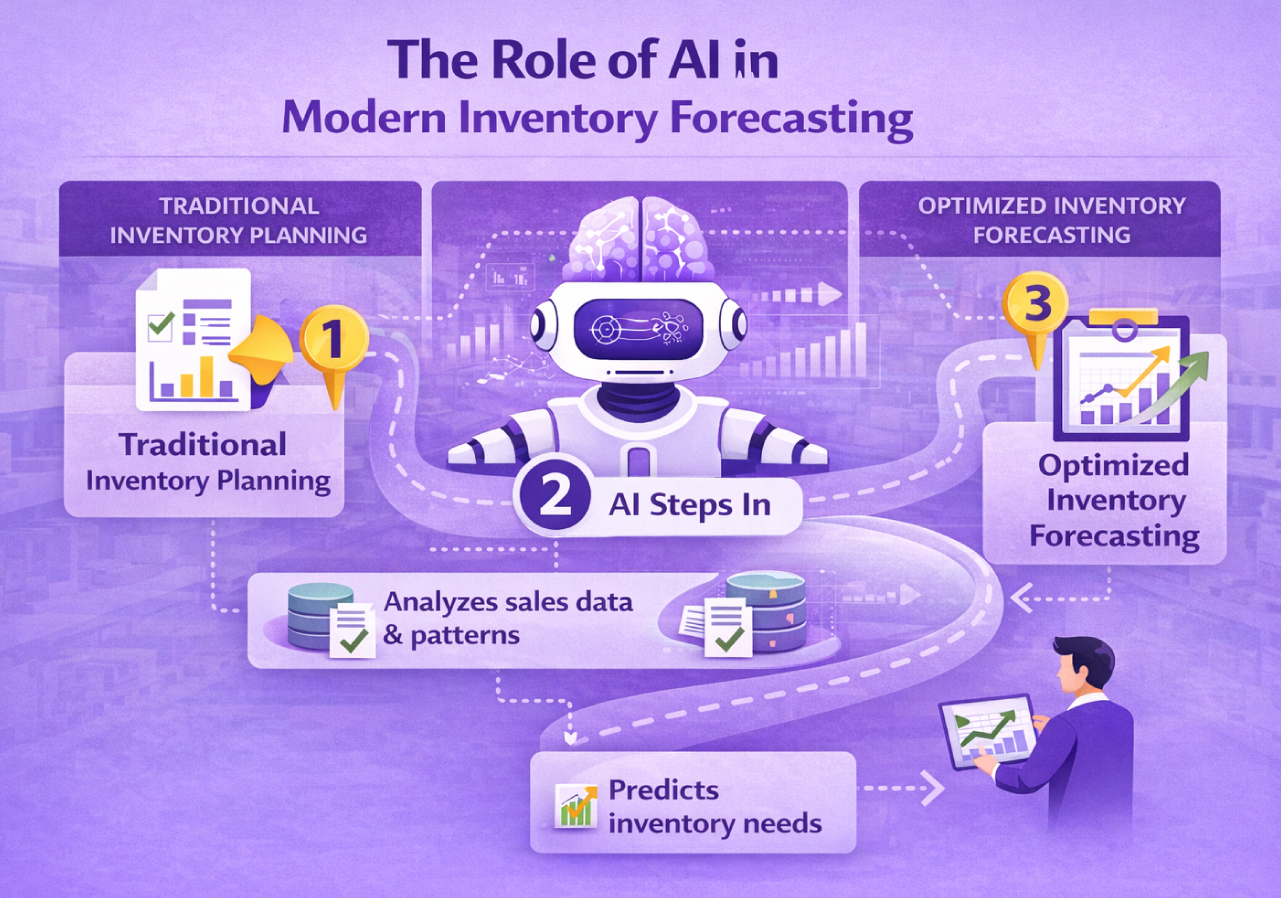
Data Inputs Powering IKEA’s AI Forecasting Models
Accurate forecasts don’t come from smarter algorithms alone; they come from richer, connected data. At IKEA’s scale, AI models rely on multiple layers of data to understand demand not just in hindsight, but in real time and ahead of time. Here are the key data inputs that power IKEA’s AI-driven forecasting:
- Historical sales data across regions: Years of sales data across countries, cities, and product categories help AI models identify long-term patterns, recurring cycles, and regional demand differences. This historical context allows forecasting systems to distinguish between one-off spikes and repeatable trends.
- Store-level and warehouse-level inventory data: Real-time visibility into stock levels across stores and warehouses ensures forecasts are grounded in operational reality. AI uses this data to understand product movement, replenishment speed, and stock imbalances, helping decide not just what to stock, but where to stock it.
- Customer behavior and buying patterns: Browsing behavior, purchase frequency, basket combinations, and channel preferences (online vs in-store) reveal early demand signals. AI models detect subtle shifts in customer intent long before they appear in sales numbers, enabling proactive inventory planning.
- External signals: Demand doesn’t exist in isolation. AI incorporates seasonal cycles, planned promotions, pricing changes, and broader economic signals to adjust forecasts dynamically. This helps IKEA prepare for predictable surges and respond faster to unexpected shifts.
AI + Human Decision-Making at IKEA
At IKEA, AI is not positioned as an autonomous decision-maker. Instead, it acts as a decision-support system, augmenting human judgment rather than attempting to replace it. This balance is critical when operating a global supply chain with millions of moving parts.
Why AI supports planners, not replaces them?
AI is excellent at analyzing enormous amounts of data, spotting trends, and producing projections quickly, tasks that are hard to complete by hand at IKEA's size. But AI is unable to completely understand the context of inventory planning, which includes long-term brand concerns, supplier relationships, regional business objectives, and strategic priorities.
Forecasts produced by AI are used by planners as a starting point rather than a definitive solution. Humans determine how aggressively to respond to the situations, confidence ranges, and recommendations provided by the algorithm. As a result, decision-making remains grounded in business reality and data-driven.
Human oversight for exceptions and edge cases
It is not possible to forecast every demand using past data. Automated projections may fail in edge instances due to unforeseen occurrences, supply disruptions, regulatory changes, abrupt changes in consumer attitude, or geopolitical factors.
When it comes to examining anomalies, challenging odd predictions, and overriding AI outputs when needed, human planners are essential. This monitoring guarantees resilience: instead of mindlessly adhering to statistical patterns, the system adjusts to the complexity of the real world.
Collaboration between data teams and supply chain teams
Effective AI forecasting at IKEA depends on tight collaboration between data scientists, engineers, and supply chain professionals. Data teams focus on model accuracy, data quality, and system scalability. Supply chain teams contribute domain expertise, including how products move, where bottlenecks occur, and what operational constraints exist.
This collaboration creates a feedback loop: planners validate forecasts, flag mismatches, and share on-ground insights, which data teams use to refine models. Over time, this shared ownership improves both trust in the system and forecasts performance.
The result is not an “AI-run supply chain,” but a human-led, AI-powered operation, where machines handle complexity and humans retain control over critical decisions. This partnership is what allows IKEA to scale forecasting intelligence across global warehouses without losing flexibility or accountability.
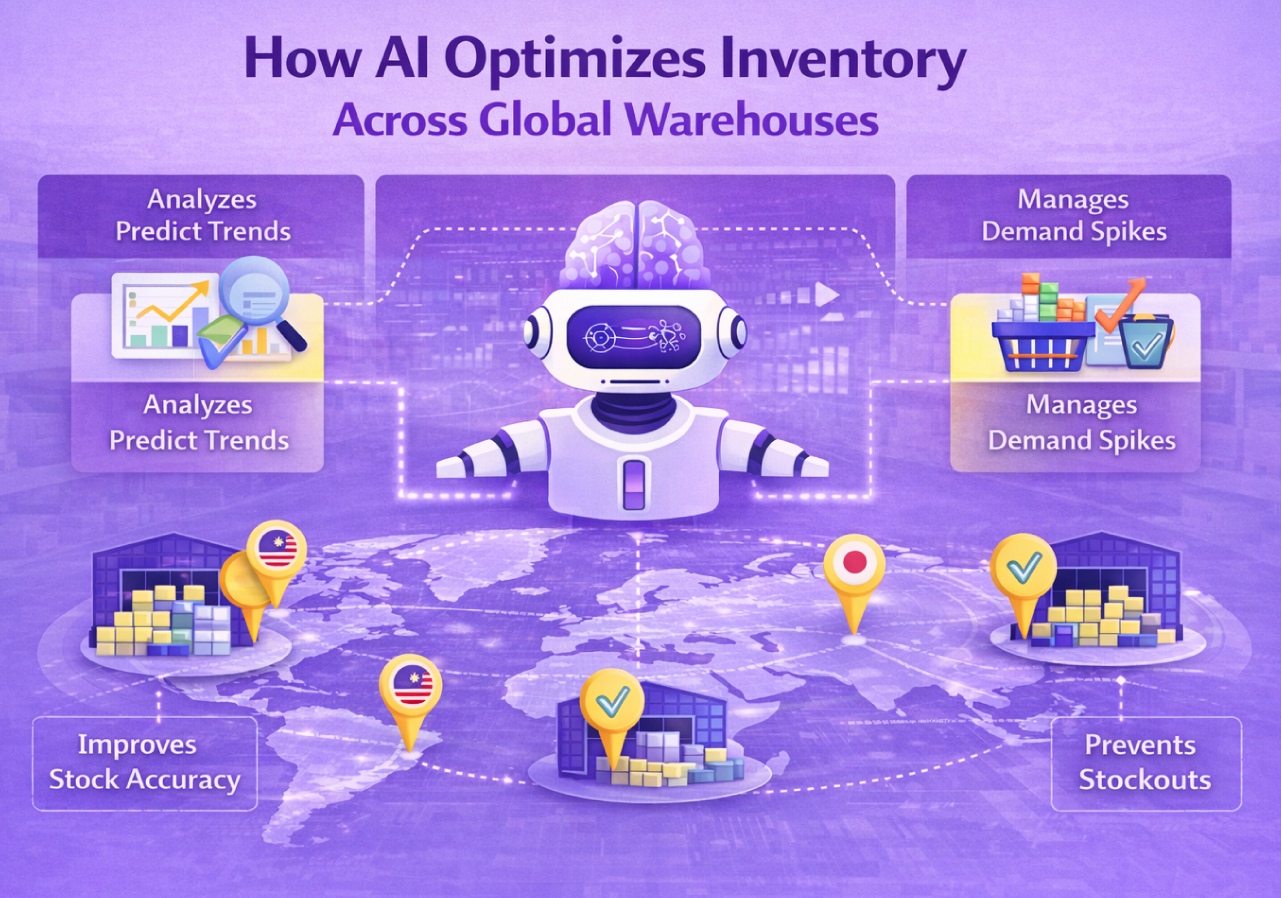
Key Lessons for Other Enterprises
IKEA’s approach to AI-driven inventory forecasting offers clear, transferable lessons for organizations looking to apply AI at scale. Technology matters, but the way it’s adopted matters even more.
Start with clean, connected data: AI models are only as reliable as the data feeding them. Before investing in advanced algorithms, enterprises must ensure their data is accurate, consistent, and connected across systems. Disconnected sales, inventory, and supply chain data create blind spots that no model can fix. Strong data foundations come first; intelligence follows.
Focus on high-impact use cases first: Rather than trying to “AI-enable everything,” IKEA focuses on areas where better predictions directly affect cost, customer experience, and sustainability. Enterprises should start with problems that are measurable and repeatable, where even small improvements create out sized business value. Early wins build confidence and momentum.
Treat AI as a capability, not a one-time project: AI forecasting is not something you implement once and move on from. Models must continuously learn, adapt to new data, and evolve with business needs. Organizations that succeed treat AI as a long-term capability, supported by processes, people, and governance, not as a standalone technology initiative.
Balance automation with human judgment: Automation drives efficiency, but human judgment ensures resilience. IKEA’s model shows that AI works best when it augments human decision-making rather than replacing it. Enterprises should design systems where people can question, override, and refine AI outputs, especially in high-stakes or uncertain scenarios.
IKEA’s deployment of AI in inventory forecasting is a very good example of how the biggest impact can’t just be the result of technology alone, but rather how strategically it is used. When they combine clean data, smart models, and human judgment, IKEA turns forecasting not into an operational necessity but into a real competitive advantage.
For enterprises, the takeaway is clear: AI is most effective when it is handled as a long-term capability that enhances decision-making, cuts down on waste, and grows together with the business. The future of inventory planning lies not in being totally automated, but in being smartly augmented.
Looking to apply AI with the same clarity and discipline seen at global enterprises like IKEA?
At AtliQ Technologies, we help organizations move beyond experimentation, designing proof-first AI solutions that deliver measurable impact across forecasting, operations, and decision-making.
Talk with us to explore how AI can turn your data into a strategic advantage, not just another dashboard.