-1%20(1).jpg)
You open Tinder thinking you’ll just swipe for a minute.
One profile. Then another. Maybe one more.
Suddenly, it’s been 20 minutes, and you don’t even remember why you opened the app in the first place.
It doesn’t feel forced. It doesn’t feel like you’re being “hooked.” It just… flows.
But here’s the uncomfortable truth: That experience isn’t accidental.
Behind every swipe is a system that’s constantly learning about what you like, what you ignore, how fast you decide, and even when you’re most likely to come back. Tinder isn’t just showing you profiles. It’s predicting your behavior in real time.
And here’s what most people miss…. this isn’t happening because of the recent AI boom. Tinder has been doing this for years, long before “AI” became a buzzword in every boardroom and LinkedIn post.
The difference?
They didn’t start with AI as a trend.
They built systems that learn from user behavior and quietly turned engagement into a science.
The real story here isn’t about dating.
It’s about how AI has been shaping user behavior all along and what most businesses are still getting wrong.
Behind the Swipe: Tinder Is an AI System, Not Just an App
What feels like a simple swipe experience is actually a highly intelligent system working in the background.
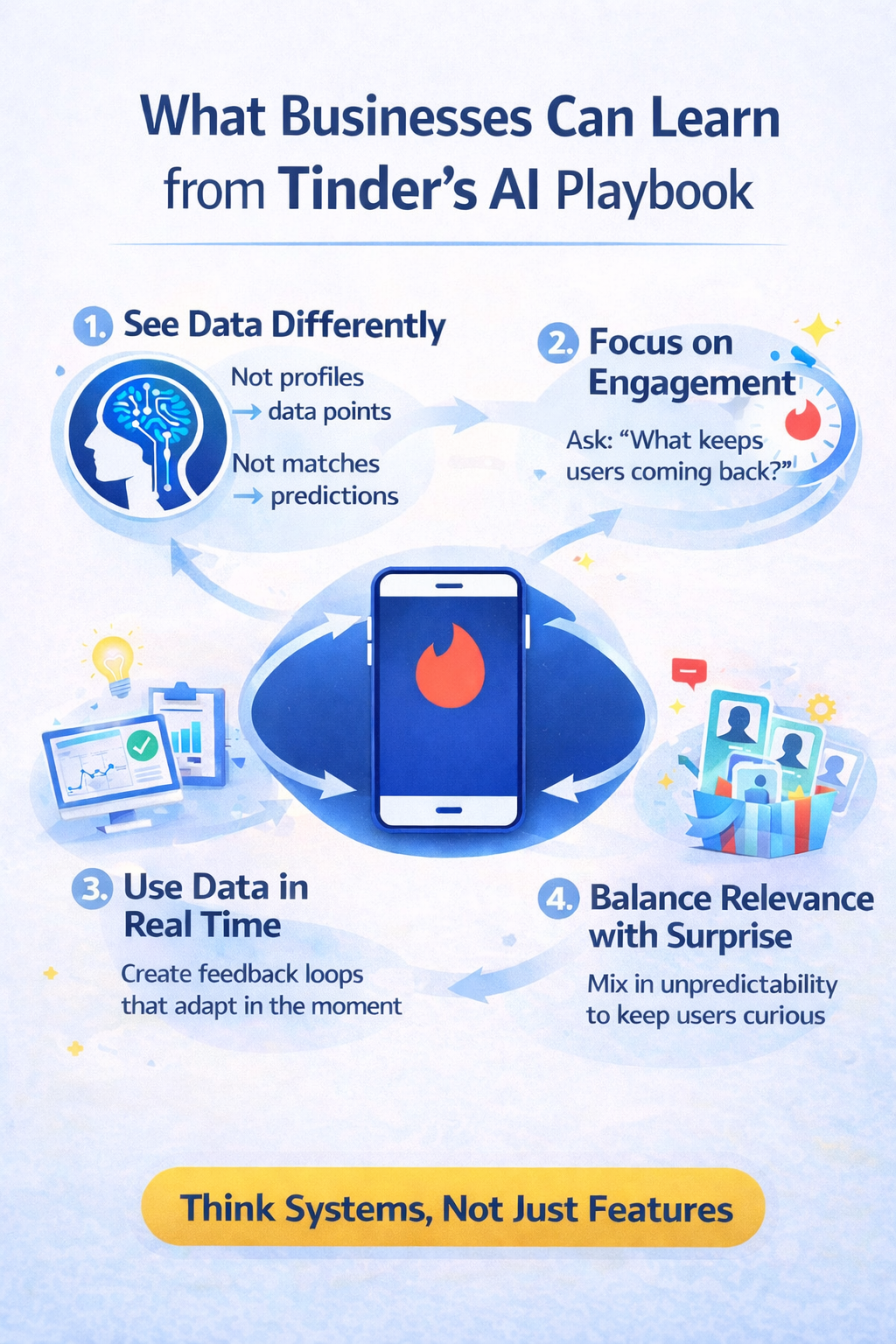
Tinder doesn’t see profiles the way users do. It sees data points, patterns of behavior, preferences, and interactions. And what feels like a “match” to you is, in reality, a prediction made by the system.
Every swipe, pause, and click feeds into a larger model that’s constantly learning and refining what to show next.
Because Tinder isn’t just about connecting people. It’s optimizing for something much bigger:
- How long do you stay engaged
- How likely are you to get a match
- How often do you come back
At its core, Tinder is continuously answering one critical question: “Who should you see next to keep you engaged?”
And everything you experience on the app is built around getting that answer right.
The AI Mechanics: What’s Actually Happening Under the Hood
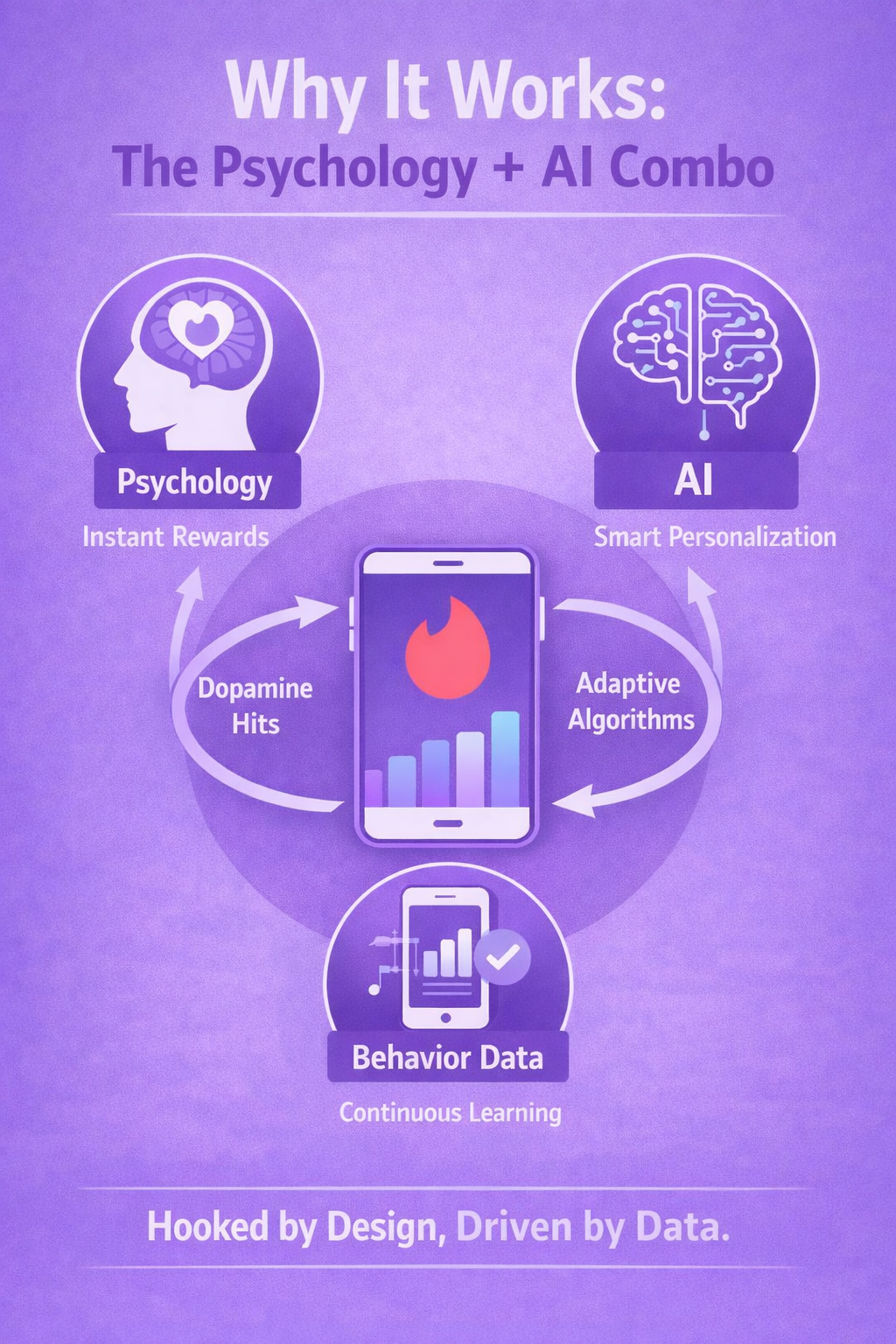
What looks like a simple swipe interface is actually a constantly evolving AI system making thousands of micro-decisions in real time. Every time you open Tinder, the app isn’t just showing random profiles. It’s curating a feed specifically designed for you based on everything it has learned about your behavior.
Let’s break down what’s really happening behind the scenes.
At the core is a personalized ranking system. Tinder doesn’t treat all profiles equally. Instead, it ranks them based on how likely you are to engage. Your past swipes influence this ranking, the types of profiles you spend more time on, and even subtle patterns like how quickly you make decisions. Over time, the system starts identifying your preferences, sometimes even before you consciously realize them yourself.
This is why two users in the same location can open Tinder at the same time and see completely different profiles. The app isn’t showing what’s available; it’s showing what’s most relevant.
Then comes the idea of a desirability or compatibility score. While Tinder’s earlier model was often compared to an ELO rating system (similar to chess rankings), today’s approach is far more complex. It considers multiple factors, profile activity, engagement levels, and how other users interact with you. This helps Tinder balance the ecosystem, ensuring that matches feel meaningful rather than random.
In simple terms, the system isn’t just trying to match you with someone you like; it’s trying to match you with someone who is also likely to engage with you.
Another powerful layer is continuous feedback loops. Every swipe you make becomes training data. A right swipe signals interest. A left swipe signals disinterest. But it goes deeper than that. How long you look at a profile, whether you revisit it, and whether you message after matching all of these signals help refine the system further.
This creates a loop where the more you use the app, the better it gets at predicting your behavior. Over time, the experience feels smoother, more intuitive, and more “aligned” with your preferences, because it actually is.
But Tinder doesn’t just optimize what you see. It also optimizes when you see it.
Through behavioral analysis, the system identifies patterns in your activity when you’re most likely to swipe, when you’re more responsive, and when you’re likely to return. This is where timing intelligence comes in. Notifications aren’t random; they’re strategically timed nudges designed to bring you back at the moment you’re most likely to engage.
And then there’s one of the most underrated elements: controlled randomness.
If Tinder only showed you perfect matches every time, the experience would quickly become predictable and boring. Instead, the system introduces a level of unpredictability. Not every profile is an ideal match. Some are slightly outside your usual preferences. This creates a sense of curiosity, the feeling that the next swipe might be the one.
It’s the same principle used in games and social platforms: variable rewards keep users engaged far longer than predictable outcomes ever could. Put all of this together, and what you get isn’t just a dating app. It’s a system that learns, adapts, and evolves with every interaction.
And that’s the real takeaway.
Tinder’s success isn’t just about matching people; it’s about building an experience that gets smarter every time you use it.
Where Most Businesses Get It Wrong?
Most businesses don’t struggle with AI tools. They struggle with how they approach AI. Here’s where things usually go wrong:
- AI as a feature, not a system: Adding chatbots or recommendations ≠ for real intelligence. No learning, no evolution
- Feature-first thinking: More features, more complexity. But no focus on what keeps users coming back
- No feedback loops: Data is collected but not used in real time. Product stays static, experience doesn’t improve
- Ignoring user behavior: Same experience for everyone. No personalization, no relevance
- Bad timing: Random notifications, generic emails. No understanding of when users engage
- Over-optimizing predictability: Everything becomes too safe and repetitive. No curiosity, no stickiness
The real gap isn’t technology. It’s thinking. Most businesses build products that work. Very few build products that learn.
How AtliQ Approaches AI Differently?
At AtliQ, we don’t start with AI. We start with the problem.
Because in most cases, the issue isn’t the lack of tools, it’s the lack of clarity. That’s why our approach begins with understanding your business deeply, where time is being wasted, where decisions are slowing down, and where user experience is breaking down. Only once that clarity is in place do we bring in AI.
But more importantly, we don’t look at AI as a one-time feature. We focus on building systems that learn and improve over time. Whether it’s personalization, recommendations, or automation, the goal is always the same: to create something that gets smarter with every user interaction.
This is where most implementations fall short. They deliver functionality, but not evolution. At AtliQ, we design for both.
And we do it with a strong focus on real outcomes, better engagement, higher retention, and measurable efficiency. Not just “AI-powered” labels, but actual impact on how your business operates and grows.
Because in the end, AI isn’t valuable because it exists. It’s valuable when it continuously learns, adapts, and drives better decisions.
And that’s the difference in how we build.
Tinder didn’t win because it was a dating app.
It won because it built a system that learns from every user and gets better with every swipe.
That’s the real shift.
If your product isn’t learning, adapting, and improving with user behavior, it’s not just missing out; it’s falling behind.
The question isn’t “Should you use AI?” It’s “Where can AI actually make your product smarter?”
If you’re thinking about building that kind of system, let’s start with clarity, not code. Book a free discovery call with AtliQ, and let’s find where AI can truly drive growth in your business.